
How to Choose the Right Air Duct Cleaning Company in Kirkland
Washington State doesn’t license duct cleaners. That means the company with the slickest website and the company with a used shop vac and magnetic door signs are operating under identical legal standing, so the vetting has to come from you. If you’ve been comparing quotes in Kirkland and can’t tell why one is $149 and another is several times that, the price isn’t the real question. The real question is who’s showing up, with what equipment, and whether anyone will verify the work afterward. Here’s the checklist we’d use ourselves.
If you’d rather hand the screening to a specialist, call (833) 509-3011 and we’ll walk you through exactly what a Kirkland job involves before anyone books a visit.
What should I actually ask on the first phone call?
Five questions separate a professional from a van operator, and most companies reveal themselves within ten minutes. Don’t let them rush you with a “no problem, we do that all” answer. Write the answers down.
- What equipment do you run, specifically? A real specialist names their platform. We run Rotobrush and Nikro systems, the same equipment commercial HVAC contractors rely on. “We use a powerful vacuum” tells you nothing.
- How do you price? Per-vent pricing with no system cap is what causes the bait-and-switch. Ask whether the number is a whole-system price agreed before work begins. If the answer shifts to “it depends on how many vents,” that’s a warning sign.
- How will you verify the cleaning? Professionals use before-and-after documentation. A company that just says “trust us” isn’t verifying anything.
- What happens if the ducts weren’t installed right? This is the one that trips most people up. Ducts leak at joints, pull apart at flex connections, and collect debris wherever seals have failed. If the answer is “we just clean,” you’ll be back on the phone in a year wondering where the buildup came from. We repair and seal what we find, rather than cleaning around it.
- Do you own the equipment? Ask how long it takes from booking to arrival, and what they’ll bring. If they’re subcontracting or renting a machine from a box store, that’s the question after the question.
Any company that dodges number one or number two is disqualified. Not “worth a second look.” Disqualified.
Does NADCA membership mean what companies claim it means?
The National Air Duct Cleaners Association (NADCA) sets industry standards, including the ACR and Assessment, Cleaning and Restoration standard, and offers a certification exam for technicians. Here’s the honest version: membership signals a company invested in industry standards and technical training, which matters. But it’s not a license, and it’s not a go-out-of-business card. A company can claim NADCA alignment while its technicians have never sat an exam.
How to verify:
- Ask which NADCA standard they follow, specifically. The ACR standard is the one worth naming. If no one on the call knows what you’re talking about, that’s your answer.
- Ask whether the technicians who’ll arrive are NADCA-certified or trained to the standard the company claims. “We’re members” versus “our people are trained” are different claims.
- Look it up. NADCA publishes a directory of member firms. If the company isn’t listed and still says “NADCA certified,” you’ve learned something worth knowing before you open the door.
No license in Washington State means no single authority to check. Membership is one signal among several, and it only holds weight when the company can explain it. Local homeowners deserve a straight answer when they ask, “what does that actually mean for my ducts?”
Why aren’t Google reviews enough to choose a company?
Google reviews are useful, but they’re also the easiest thing to game. A run of glowing five-star reviews from customers who can’t distinguish a thorough cleaning from a rushed one tells you the company is charming, not that it’s thorough. Many people leave a review based on booking, punctuality and politeness, which are real, but say nothing about whether the work was mechanized and verified.
Look at the shape of the review history instead:
- Complaint patterns. One bad review is a bad day. Three reviews describing surprise final invoices or no post-job verification is a system.
- Response patterns. How a company responds to a legitimate complaint tells you how it will respond to yours. Professional responses own the problem. Defensive ones blame the customer.
- BBB complaint history. Ask the Better Business Bureau how complaints were resolved, not just how many exist. A pattern of complaints about unexplained charges is worth more than a hundred five-star raves.
- Detail specificity. A review that says “they showed me before-and-after photos of my own ducts” is worth ten that say “great job.”
In Kirkland, where neighborhoods like Bridle Trails and Houghton have plenty of older homes with ducts that were never designed for today’s filtration, the meaningful review detail is whether the company actually addressed the problem it found.
Does the company own its equipment, or rent it?
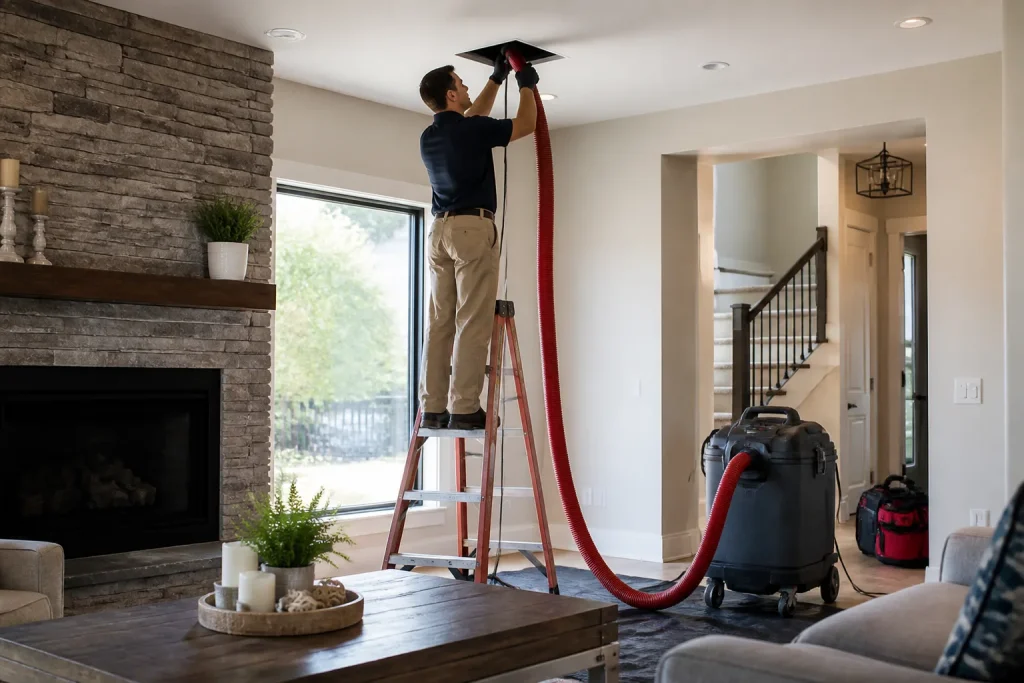
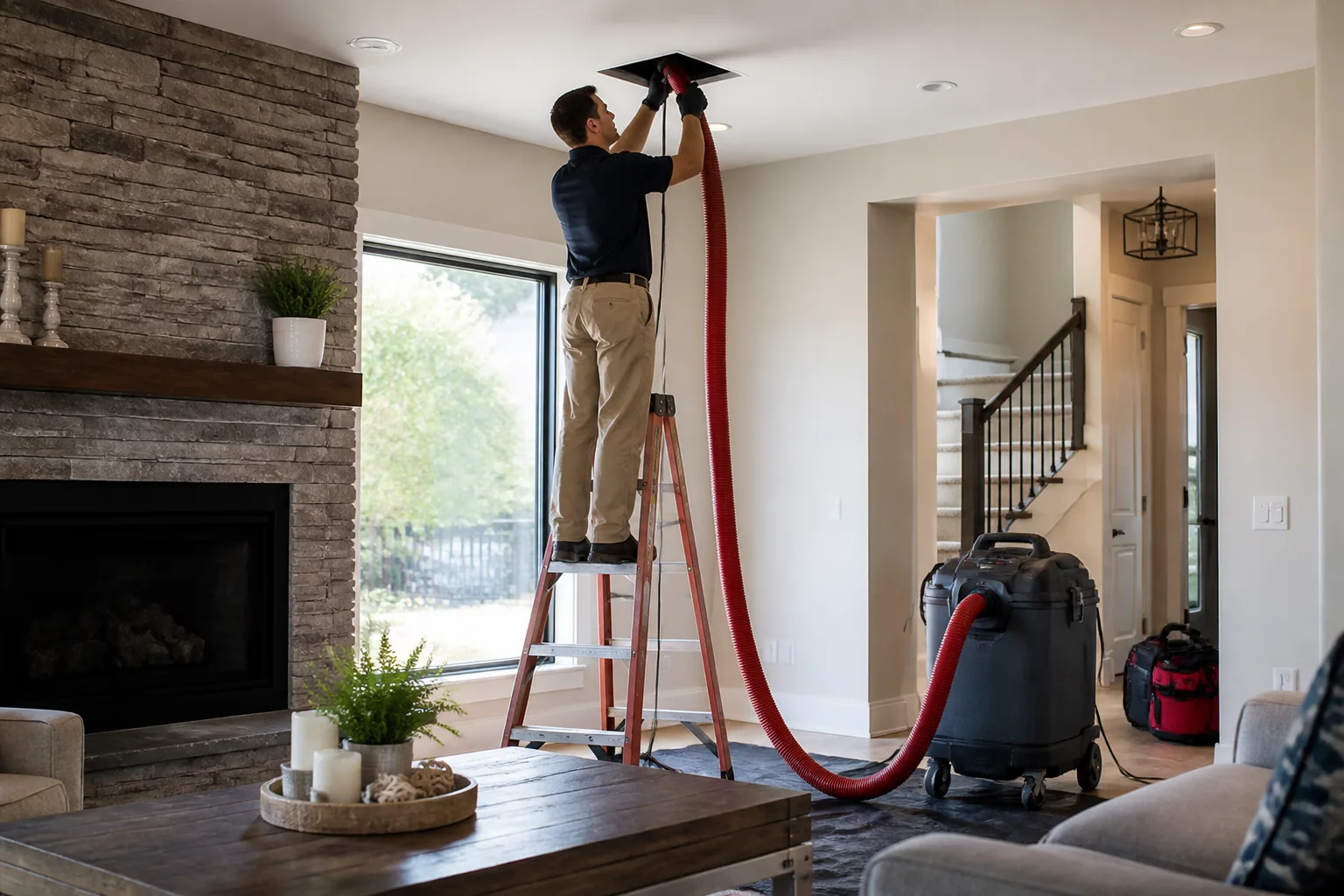
You can find out in about 30 seconds. Ask: “What equipment will the technician bring, and is it yours?” Listen for two things. First, whether they name the machine or platform (we use Rotobrush and Nikro), which a company that owns its equipment will do without hesitating. Second, whether they describe a capture system. A professional operation runs Abatement Technologies air-filtration equipment during service to actively capture dislodged contaminants inside the home. Someone renting a vacuum from a box store won’t describe any of that, because it’s not their setup.
Ask a follow-up: “What happens to the dust that comes loose?” A real answer explains the containment. A vague answer – “it goes into the machine” – tells you the dust is going into your air. And if the company also outsources dryer vent work to a different vendor, you’ve now got two companies, two standards, and two people to call when something goes wrong.
Owning the equipment also means owning the outcome. A specialist can repair and seal what it finds, install Honeywell or Aprilaire air-quality components afterward, and verify the result. A company that rents a vacuum and subcontracts the rest can’t do that. From intake to exhaust, every air pathway should belong to one company. We cover cleaning, repair, sealing, sanitizing, and dryer vent cleaning under one roof so you don’t have to coordinate vendors.
What does a legitimate pre-job walkthrough look like?
Every legitimate job starts with a walkthrough before any price is agreed. If a company quotes over the phone without seeing the system, it’s guessing. You’re not buying an estimate, you’re buying the actual scope.
A thorough walkthrough in a Kirkland home typically includes:
- Checking whether the return ducts and supply runs can be reached, and where the critical junctions are.
- Inspecting the air handler and accessible HVAC components, since duct cleaning and HVAC cleaning belong together. Cleaning one and not the other leaves the contamination circulating.
- Looking at flex duct connections and existing seals. Poorly sealed joints are where dust enters and cold air escapes. Repairing them is part of a proper scope.
- Locating the dryer vent and checking for lint accumulation, one of the leading causes of residential fires. Not every company includes it.
- Doing a visible inspection of the supply and return registers, with notes on any that need sanitizing or repairs.
- Documenting conditions and agreeing on a price before anything is touched.
What does that buy you? It buys a price that reflects your system rather than a coupon negotiated over the phone. It also flips the usual script: the final invoice should match the estimate because the scope was set before work started. No per-vent math surprises.
When should you call a professional instead of waiting?
If you have any of the following, you don’t need to keep researching – you need a specialist to look at the system:
- Visible dust streaks around registers, or a musty smell that returns after cleaning the room.
- Recent renovation (drywall dust is fine enough to travel everywhere and settle inside the system).
- Allergy or asthma symptoms that worsen indoors, especially in homes with pets.
- A dryer that takes noticeably longer to dry a load, or a vent you can’t reach to inspect.
- An HVAC system you know has never been professionally serviced.
Our technicians have up to 9 years of experience, and the assessment is genuinely free. If you’re in Kirkland, we’ll walk the system with you, tell you what we find, and give you a written estimate. What we won’t do is quote a per-vent price over the phone.
Related services in Kirkland: air duct cleaning covers the supply and return runs plus the air handler; if your system needs more, we can add sealing or an air-quality upgrade in the same visit.
The Bottom Line
The company with the slick website and the company with the magnetic door signs may have identical legal standing in Washington. That means your vetting is the filter. Phone screen them on equipment, pricing structure, and verification. Confirm NADCA membership rather than taking it at face value, and read the shape of the review history, not just the stars. Look for a pre-job walkthrough before any price is agreed. A legitimate company will show you what’s actually inside your ducts – literally, with before-and-after photos of your own system – and price it as a whole-system job.
If you’re in Kirkland and need help, Kirkland Air Duct Cleaning Pros offers free estimates. Call (833) 509-3011. We answer 24/7. Fast dispatch from 7am to 7pm, Sunday through Friday.
Frequently Asked Questions
Before-and-after photos of your own system are the standard proof – not stock images of someone else’s job. A professional operation documents the registers, the air handler, and the accessible ductwork before it starts and after it finishes, then shows you the comparison. We also run Abatement Technologies air-filtration equipment during the job so the contaminants are captured inside the home, not just displaced. If a company can’t show you verification of your own job, ask how they know the work was done. Call (833) 509-3011 for a free estimate and a straight answer.
No – Washington State does not require a specific license for air duct cleaning. Because there is no state license to check, screening a company is entirely your job: ask about equipment, pricing structure, verification, and NADCA training. Memberships and certifications are useful signals, but they are not a license, and they should not be treated as a substitute for asking direct questions. Any local pro you hire should be able to discuss their process in specific mechanical terms rather than in slogans.
A very low quote usually means a per-vent price with no cap, a consumer-grade vacuum you could rent yourself, or a job that skips the repair and verification steps. The catch is that the cheap quote is often the opening number, and the final invoice arrives after the work starts. Look for one flat price for the whole system, agreed before work starts, based on a walkthrough of your actual ducts. We don’t quote per vent, because price should reflect your system, not a vent count. Call (833) 509-3011 for an exact estimate – estimates are free.
Most households can go two to three years between professional cleanings, but that changes if you’ve had a renovation, have pets, have allergy or asthma sufferers in the home, or have never had the system serviced. The more useful question is whether your system has a problem – leaks, poor seals, a clogged dryer vent – that cleaning alone won’t fix. If ducts aren’t sealed properly, dust keeps coming in after every cleaning. Ask any company you call whether they repair and seal what they find, and then call (833) 509-3011 if you’d like us to look. Estimates are free.
Written by the team at Kirkland Air Duct Cleaning Pros.
Need Air Duct Cleaning Help?
Call Kirkland Air Duct Cleaning Pros - the local pro we connect you with is licensed and insured, here with fast help in Kirkland.
(833) 509-3011