
Honeywell Air Duct Cleaning in Kirkland: A Homeowner’s Guide
Most people who call us about a Honeywell air cleaner want a filter changed or a lamp replaced. The real question is upstream of that. Honeywell’s whole-home air quality systems – media filters, electronic air cleaners, UV germicidal lights – are rated to perform in air that meets a certain cleanliness threshold. If the ductwork feeding them has accumulated biofilm and years of particulate on its surfaces, they’re doing their best with air that’s already been contaminated once. This guide walks through how that interaction actually works, and what it means for a home in Kirkland. If you’d rather have a specialist look at it directly, call (833) 509-3011.
How does a Honeywell system interact with contaminated ductwork?
A Honeywell media filter or electronic air cleaner sits at one point in the system, usually at the air handler or return plenum. It captures particles passing through that point. What it cannot do is clean the surfaces downstream or upstream of itself. Those surfaces – the inside of the supply and return ducts – accumulate whatever bypasses the filter on each cycle.
When a Honeywell electronic air cleaner is installed, its efficiency rating assumes air arriving at its collector cells is within a certain particulate load. If upstream duct surfaces have developed a biofilm layer (common in Kirkland’s humid months, where indoor relative humidity stays higher longer), the cells are receiving a heavier particle stream than the unit was designed to see. The cells still work. They just work harder, load faster, and need washing more often.
A few things that determine how significant this interaction is:
- Housing age and duct material. Galvanized steel holds biofilm differently than flex duct with a rough interior surface. Flex duct tends to trap more on its ribs.
- Return-side contamination. Most homes we examine have more buildup on the return side than the supply side, because the return carries unfiltered household air toward the filter. That upstream contamination is what a media filter meets first.
- Filter bypass. An improperly seated Honeywell filter, or a cabinet with gaps, lets unfiltered air around the filter and into the duct. That’s particulate the cleaner never sees.
In our experience, when a Honeywell system is being blamed for poor performance, the filter or EAC is often fine. The ductwork is the variable.
What maintenance intervals does Honeywell recommend, and how does duct condition change them?
Honeywell’s published maintenance guidance for its media filters and electronic air cleaners assumes normal residential dust loading, and specifies filter replacement or cell cleaning intervals on that basis. Those intervals are a baseline, not a promise. Duct condition moves them.
Here’s the practical reality in Kirkland. We sit in a climate with a long, wet shoulder season and a mixed pollen calendar that runs from early tree pollen through grass season. A home with airtight construction and a family with pets may load a Honeywell media filter considerably faster than the manufacturer’s baseline suggests. A home with a cleaner interior and a well-sealed duct system may run longer.
The variables that most affect Honeywell filter and EAC life in this region:
- Humidity exposure. Kirkland’s cool, moist months keep indoor humidity elevated enough that organic material on duct surfaces stays active longer than in drier climates. That biofilm releases particles into the airstream continuously.
- Return duct surface condition. If the return duct surfaces have never been cleaned, the filter is the only barrier between the home and the air handler. That means the filter carries the whole load.
- Pollen ingress through open windows and doors. Spring and early summer here bring a heavy particulate load into the return system. Homes with windows open more often see faster Honeywell filter loading.
- EAC cell wash frequency. A Honeywell electronic air cleaner needs its cells washed more often when upstream contamination is high. If you’re washing cells every two weeks instead of every month, that’s a signal the duct condition is driving the schedule.
Having the duct system cleaned sets a known baseline. From that point, Honeywell filter and EAC maintenance runs on the schedule the equipment actually needs, not on compensating for years of accumulated load.
What happens to UV germicidal lamp effectiveness when duct surfaces carry organic debris?
This is one of the most misunderstood pieces of the Honeywell air-quality lineup. A UV germicidal lamp is effective when it has unobstructed line-of-sight to the surface or airstream it’s treating, and when the surface it’s illuminating is clean. Organic debris on duct walls and on the coil absorbs UV energy and shields the microorganisms beneath it. The lamp is doing its job; the geometry and the surface are working against it.
We’ve seen this pattern in Kirkland homes with UV lamps installed on systems that had never been professionally cleaned. The lamp bulb is bright and the homeowner assumes the system is protected. The lamp is treating a thin layer of moving air, but it can’t penetrate the biological film on the coil and downstream surfaces. That film is exactly where the lamp needs to work, and it can’t, because the debris is in the way.
The correct sequence is cleaning first, lamp service after. Once duct surfaces, the evaporator coil, and the cabinet around the lamp are clean, the lamp’s line-of-sight is clear. Germicidal effectiveness then reflects the equipment’s actual capability rather than the buildup that was blocking it. For homes with UV systems, pairing air duct cleaning with a sanitizing treatment makes the lamp’s job achievable. We handle both, and we photograph the coil and cabinet surfaces before and after so you can see what the lamp had been working around.
How do you schedule duct cleaning around a Honeywell system without affecting filter or EAC warranty?
Schedule the duct cleaning before any Honeywell filter replacement or EAC cell service, and tell the technician what Honeywell equipment is in the home when you book. Manufacturers specify that equipment be serviced according to their instructions; duct cleaning itself doesn’t affect warranty, but mishandled filters, incorrectly seated EAC cells, or cleaner residue left on collector cells can. The correct order matters.
Here’s the sequence that protects the equipment:
- Inspect and document the Honeywell components first. Note the filter model, EAC cell condition, and UV lamp installation. Photograph the cabinet and the filter seat.
- Cover or bypass the Honeywell equipment before cleaning. Electronic air cleaner cells and UV lamps should be removed or isolated before the cleaning run begins. Debris dislodged during cleaning should not end up in the collector cells.
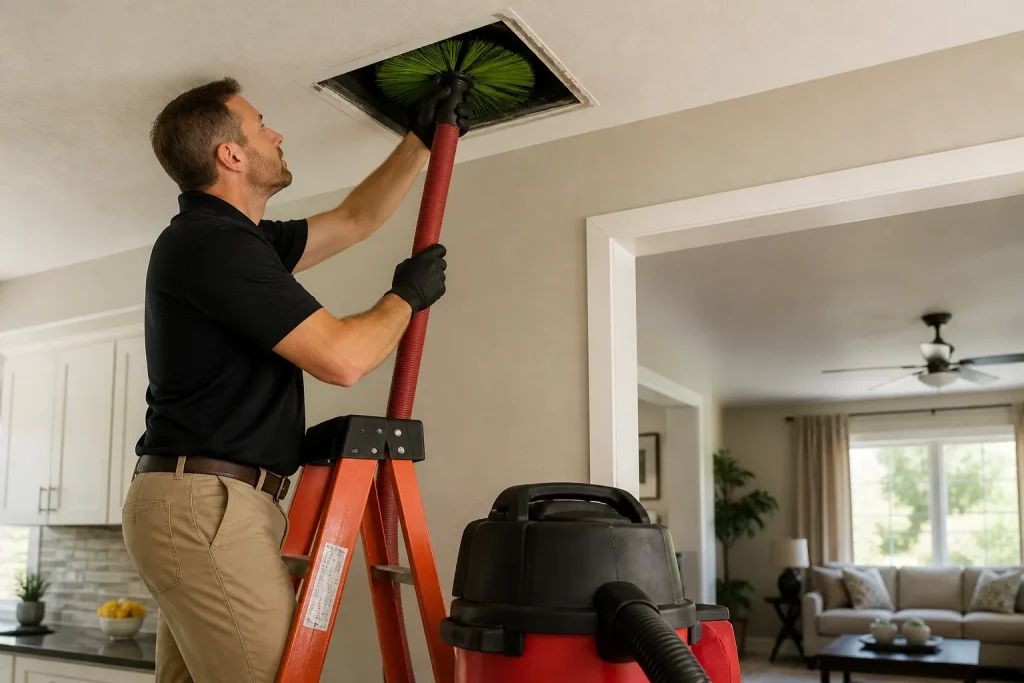
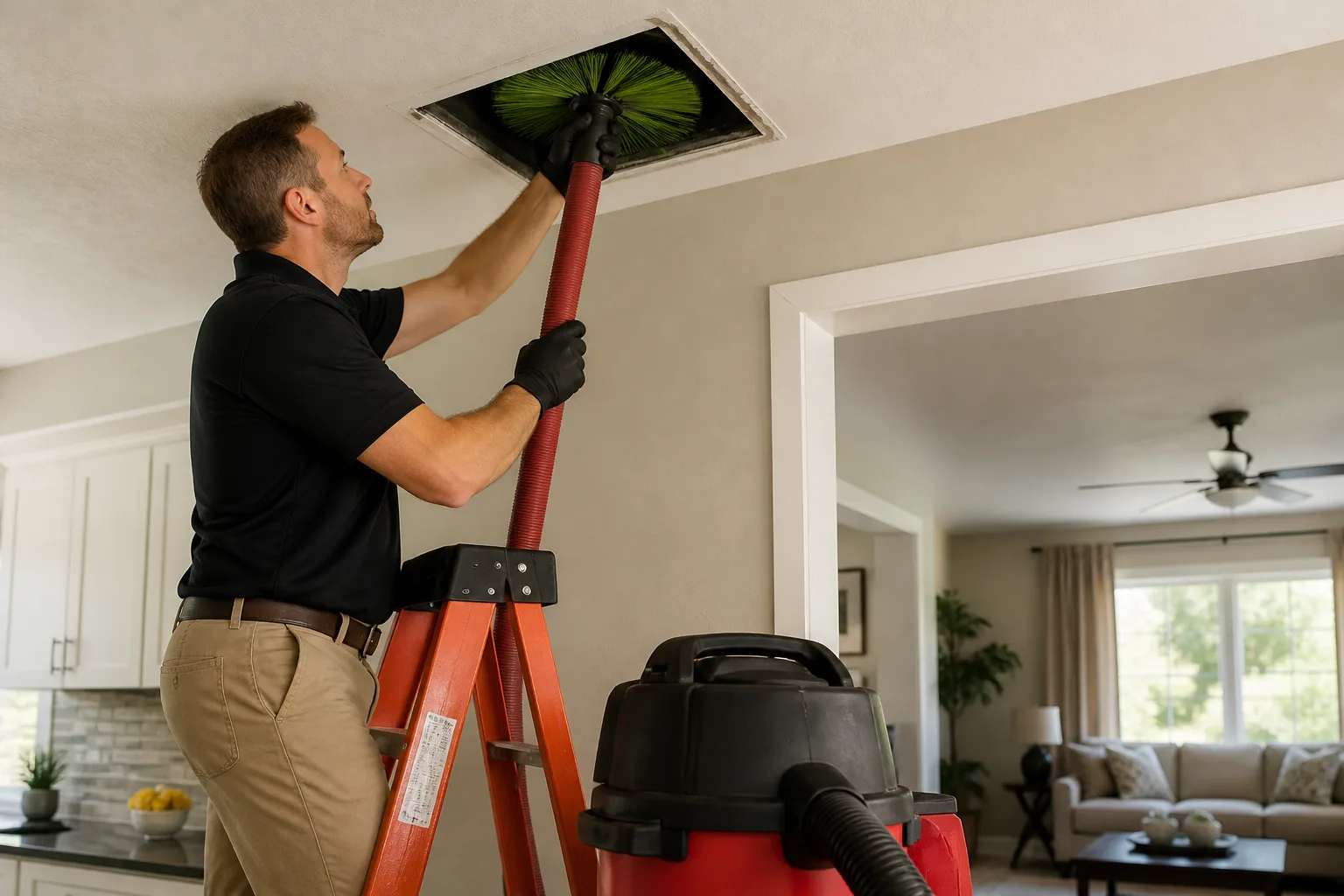
- Clean the ducts. Rotobrush and Nikro systems agitate the duct surfaces while a HEPA-filtered vacuum with Abatement Technologies filtration captures dislodged debris. This protects the home during service, which matters more when the soil load is high.
- Clean the air handler, coil, and cabinet separately. The coil and the cabinet around the UV lamp need their own cleaning pass after the ducts.
- Reinstall and verify Honeywell components. Filters should be new or confirmed clean and seated correctly. EAC cells reinstalled per manufacturer instructions. Lamps checked for function and clear line-of-sight.
If you have a Honeywell electronic air cleaner, ask that its cells be removed during cleaning. If you have a media filter cabinet, the filter element is replaced after the ductwork is clean. Both are standard steps, and any competent specialist should be doing them. We also repair and re-seal duct sections where we find gaps, which matters because a Honeywell filter can’t compensate for bypass air that’s entering downstream. You can read about the full scope on our air duct cleaning page.
What’s the correct cleaning sequence when a home has a Honeywell whole-home humidifier?
Humidifier lines are cleaned separately from the ductwork, and the duct cleaning comes first. A Honeywell whole-home humidifier introduces moisture into the supply plenum or the return, depending on the model. Over time, those lines and the humidifier’s water panel housing develop mineral scale and biological growth that’s distinct from the particulate that accumulates in dry ductwork. They’re two different cleaning problems.
The correct sequence is:
- Duct cleaning first, with the humidifier isolated. The humidifier’s water supply should be off and its bypass damper closed before cleaning begins. You don’t want debris migrating into the humidifier housing.
- Humidifier lines and water panel serviced separately. Mineral deposits on the humidifier’s internal lines need their own treatment. This is not duct cleaning; anyone who tells you the humidifier is “cleaned as part of the duct job” is skipping it.
- Post-cleaning inspection of the connection point. The humidifier’s duct connection, and the plenum around it, should be checked for moisture damage and re-sealed if needed. This is where duct repair and humidifier service overlap.
In Kirkland’s climate, home humidifiers tend to run less than in drier regions, but that doesn’t mean the lines stay clean. A system that sees intermittent use still accumulates standing water in its reservoir and scale on its water panel. Cleaning the ductwork does not address that. If you have a Honeywell humidifier and you want the whole system assessed, tell us when you call; the HVAC cleaning service includes the air handler components that interact with humidifier hardware, and we can walk through the humidifier’s own service needs separately.
When should you call a pro instead of doing this yourself?
Some of this is homeowner work. Replacing a Honeywell media filter element is straightforward, and washing EAC cells per the manufacturer’s instructions is within reach. The parts that aren’t: access to the full duct run, the HEPA-filtered negative-pressure setup that keeps dislodged debris out of your living space, coil cleaning that doesn’t damage the fins, and any repair and re-sealing work that turns up. A shop vac does not clean ducts; it stirs them.
We use professional Rotobrush and Nikro platforms on every job, the same equipment commercial HVAC contractors rely on, and we run Abatement Technologies filtration during service to capture what gets dislodged. Our technicians have up to 9 years of experience. If you’re in Kirkland and want a professional assessment before committing to anything, call (833) 509-3011. We answer 24/7. Fast dispatch from 7am to 7pm, Sunday through Friday.
Related services in Kirkland: if your home also has a dryer vent that hasn’t been serviced, that’s a documented fire hazard and worth combining into the same visit. See dryer vent cleaning for what that involves. And if you’re starting from scratch on the whole air pathway, our Kirkland Air Duct Cleaning Pros page explains how we cover supply, return, HVAC components, dryer vent, and sanitizing in a single service.
The Bottom Line
The short version: a Honeywell air cleaner, media filter, or UV lamp is only as effective as the ductwork feeding it. Contaminated upstream surfaces accelerate filter loading, shorten EAC cell wash intervals, and shield the surfaces a UV lamp is supposed to treat. Cleaning the ducts sets a real baseline so the Honeywell equipment runs on its own schedule. Repairing gaps and bypass points keeps unfiltered air from routing around the equipment. Humidifier lines get their own cleaning pass, not a mention during the duct job.
If you’re in Kirkland and need help, Kirkland Air Duct Cleaning Pros offers free estimates. Call (833) 509-3011. We answer 24/7. Fast dispatch from 7am to 7pm, Sunday through Friday. Every job is one flat price per system, agreed before work starts, and you get before-and-after photos of your own ducts so you know exactly what was cleaned. The local pro we connect you with is licensed and insured as their state requires.
Frequently Asked Questions
No, cleaning the ductwork itself doesn’t void a Honeywell warranty, as long as the equipment is handled correctly. The steps that protect the warranty are removing EAC cells and UV lamps before cleaning, seating the media filter properly after, and not exposing the collector cells to cleaning residue. Tell the technician what Honeywell equipment you have when booking so they can plan the sequence. Call (833) 509-3011 for an exact quote; estimates are free.
It depends on duct condition and household load, not just the manufacturer’s baseline. Homes with pets, exterior pollen exposure, or never-cleaned ductwork need more frequent replacement than the label suggests. Once the ducts are clean, you can start tracking the real interval for your home. A professional inspection answers this more accurately than a general rule. Call (833) 509-3011 to schedule one.
Only partially. The lamp emits the same UV energy regardless of duct condition, but organic debris on duct surfaces and the coil absorbs that energy and shields the layer beneath it. The lamp can’t compensate for buildup. Cleaning the surfaces first restores the clear line-of-sight the lamp needs to do its job. Call (833) 509-3011 to discuss pairing lamp service with duct cleaning.
Ask for before-and-after photos of your own ducts, the air handler, and the coil. A specialist doing thorough work can document what was removed. If a provider can’t show you the interior of your ducts before and after, that’s a sign to ask more questions. We photograph every job for this reason. Call (833) 509-3011 for a free estimate.
Written by the team at Kirkland Air Duct Cleaning Pros.
Need Air Duct Cleaning Help?
Call Kirkland Air Duct Cleaning Pros - the local pro we connect you with is licensed and insured, here with fast help in Kirkland.
(833) 509-3011